Cannon Balls 3D: Tower Crash
- 4.6
- Rating
- 1.00M
- Installs
- Free
- Price
 Analysis by App-foxy
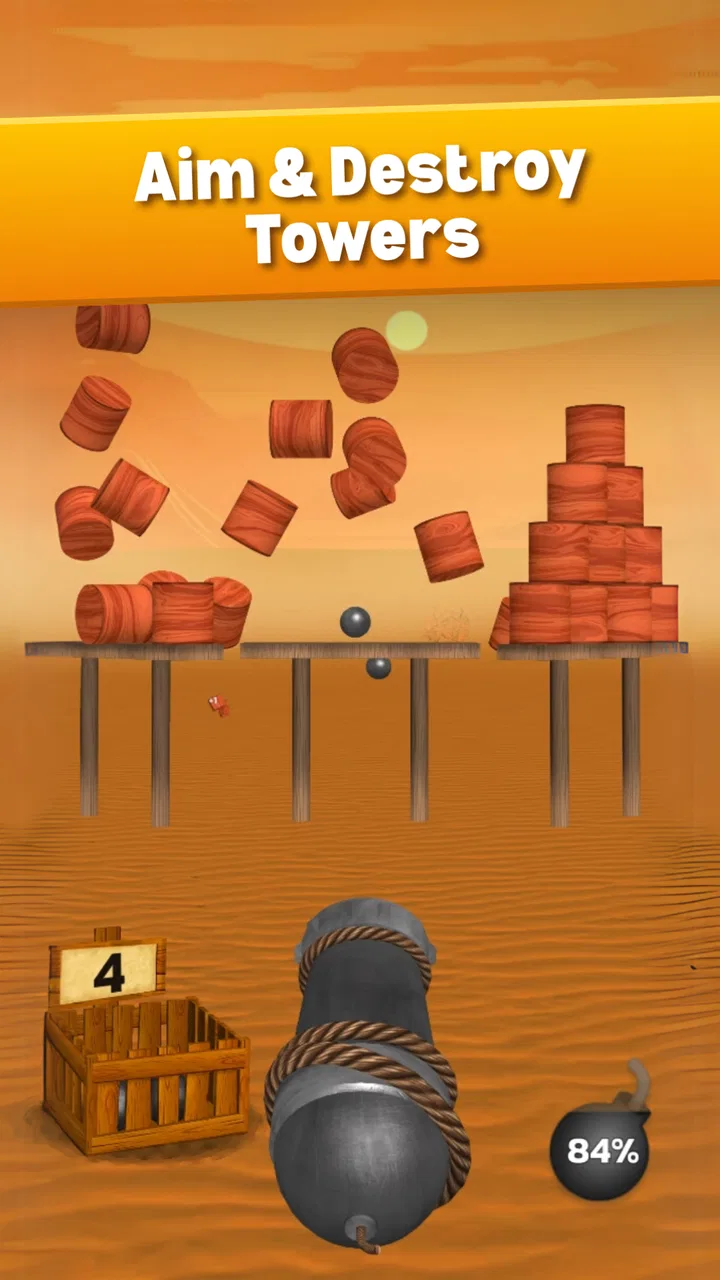
I approached Cannon Balls 3D: Tower Crash expecting a quick arcade game, and that is exactly where it fits best: short sessions, direct controls, and a simple goal that is easy to understand almost immediately. You aim a cannon, fire at a structure, and try to bring it down. The appeal is not a complicated story or a large collection of systems. It is the small satisfaction of choosing a useful angle, watching the impact, and seeing whether one shot creates enough damage to finish the job.
That straightforward design makes it a comfortable first choice for someone who wants a game that can be learned without a tutorial marathon. I found myself understanding the basic rhythm quickly, while still having a reason to adjust my aim instead of tapping randomly. It is a free arcade title from Famobi Plus, rated Everyone, and it has reached over a million installs. Those details match its broad appeal: this is the kind of game I would suggest for a short break, especially when I do not want to remember a complicated control scheme from one session to the next.
What the first few minutes feel like
The opening experience is built around immediate interaction. Rather than asking me to manage a character, explore a map, or learn a long list of buttons, the game puts the cannon and the target at the center of attention. The important decision is where to send the next shot. That keeps the first meaningful success within reach, but it also means the game depends heavily on whether you enjoy repeating a focused action and refining it.
You May Also Like

 Google Keep - Notes and lists
Google Keep’s Quiet Growth Shows the Appeal of Simpler Notes
As mobile work gets busier, Google Keep keeps winning a simple contest: capture a thought quickly, find it later, and get on with the day.

 Blood Strike: 2.5 Anniversary
Blood Strike’s Loadouts Turn Every Drop Into a Tactical Gamble
A close look at Blood Strike’s custom loadouts: how fast access to signature weapons reshapes its battle royale rhythm, rewards preparation, and narrows the gap between fights.

 Pandora - Music & Podcasts
Pandora’s Music Is Easy to Start, but Harder to Recover
Pandora’s strength is its low-effort path from a seed to a station. Its weak spot is how much confidence it asks you to place in connection, setup, and quiet recovery.

 8 Ball Pool
 Is Built on Rivalries, Rematches, and Routine
A close look at the rivalries, rematches, shared routines, and unanswered safety questions that turn a quick pool match into a persistent mobile community.

 Samsung Music
’s Quiet Strength Is Playing What You Already Own
Its reach comes less from spectacle than from dependable access to a personal library. That simplicity is both the app’s strongest retention engine and its ceiling.

 AccuWeather: Weather Radar
AccuWeather Review: A Quick, Clear Forecast for Everyday Decisions
For everyday plans, the best forecast is the one you can understand quickly. AccuWeather makes rain timing, radar, and local conditions easy to act on, with a few trade-offs.
More From Our News Desk



I recommend beginning with a patient shot instead of firing as soon as the level appears. Look at the visible shape of the tower and identify the parts that seem to hold other sections in place. Aiming at the most obvious central support is not always the most satisfying choice; sometimes a lower or side impact can make more of the structure shift. Even without treating every level like a physics puzzle, pausing for a moment gives the game more depth than simple tapping.
The phrase “3D” matters mainly because the structures have depth and the impact is easier to appreciate from a spatial viewpoint. I would not approach this as a full construction simulator or a detailed demolition sandbox. Its pleasure comes from compact challenges presented in an arcade format. The game asks for a useful decision, gives immediate feedback, and lets me try again when the result is not enough.
That makes it particularly suitable for a waiting room, a commute, or a few minutes between tasks. In an everyday situation, I could open it while waiting for an appointment, complete a few attempts, and put the phone away without feeling that I had abandoned a long mission. Players looking for a strong narrative, deep progression, or competitive multiplayer experience should set their expectations differently. Those are not the reasons I would choose this title.
Getting comfortable before chasing speed
My advice for a first-time player is to separate learning the aim from trying to finish as quickly as possible. The first shots teach how the cannon responds, how much of the tower reacts to an impact, and how forgiving the game feels when the aim is slightly off. Rushing can make the experience seem more random than it really is, because a poorly chosen angle tells you less about the structure than a deliberate attempt.
There is also a useful mental shift here: do not judge a shot only by whether it destroys everything immediately. A hit that knocks away a large section can still be valuable if it exposes a better target for the next attempt. I found the game more enjoyable when I treated each impact as information. The remaining tower shows which areas are stable and which parts are vulnerable, so the second decision can be more informed than the first.
The most reliable early habit is to study the remaining structure after every impact rather than repeating the same angle. That small pause turns a basic cannon game into a sequence of observations. It is especially helpful for players who normally find arcade games too dependent on reflexes, because careful adjustment can matter as much as speed.
From installation to the first satisfying clear
Once installed, I would start with the sound and visual feedback at a comfortable level, then focus on the control response rather than trying to memorize anything. The game’s core action is simple enough that the first goal should be practical: make one clean attempt, notice what the projectile does, and use the result to improve the next shot. You do not need prior experience with this particular title to understand the basic task.
The first successful action is likely to feel less like winning a complex level and more like solving a small physical problem. I line up the cannon, choose a point on the tower, fire, and watch how the pieces respond. When the structure collapses or reaches the required result, the reward comes from seeing that the choice of target mattered. That is the moment when the game’s loop makes sense: aim, impact, observe, and adjust.
For a new player, I suggest using the first successful clear as a reference point rather than immediately changing your whole approach. Ask what made it work. Was the target low enough to affect the base? Did the shot strike a crowded section? Did the collapse continue after the initial impact? Remembering that pattern is more useful than simply celebrating the result and moving on.
A practical technique is to aim for connected areas instead of isolated pieces whenever the layout makes that possible. A shot into a visually impressive but detached upper section may produce a dramatic hit without solving the level. A less glamorous impact near a supporting area can create a better chain of movement. This is one of the game’s quieter lessons: the most visible target is not always the most valuable one.
Another useful approach is to avoid changing several things at once. If the first shot misses, adjust either the position or the angle and then observe the difference. Large, impulsive changes make it difficult to learn what the cannon is doing. Small corrections create a clearer connection between your decision and the result, which helps the game feel more skill-based.
Why the simple loop can remain enjoyable
The strength of this design is its low mental overhead. I can return after a day away and understand what to do without rebuilding a complicated plan. That is a real advantage over arcade games that add many currencies, characters, missions, or upgrade paths before the basic action becomes enjoyable. Here, the cannon remains the focus, so the experience is easy to resume.
At the same time, the same simplicity can become a limitation. If you need constant novelty, a large variety of playable roles, or a long-term strategic system, the repeated tower-and-cannon format may feel narrow. I would not recommend it as someone’s only mobile game if they want a deep hobby. I see it more as a reliable small game that works between larger experiences.
Compared with endless runners, it asks less from your reflexes and does not require continuous movement. Compared with match-style puzzle games, it replaces pattern matching with spatial judgment and impact. Compared with large physics sandboxes, it offers far less freedom but also far less setup. That middle position is important: it is more interactive than a passive time-killer, yet much lighter than a game built around experimentation for its own sake.
Common points of confusion for new players
The first possible misunderstanding is assuming that every shot should be aimed at the tallest or most obvious part of the tower. The visual center is not automatically the structural center. I get better results when I look for a section that connects several visible pieces, particularly when a lower impact could affect what stands above it. The game becomes easier to read once I stop treating the tower as one solid object.
Another confusion comes from interpreting a partial collapse as a failed attempt with no useful outcome. Even when the level is not finished, the changed layout can reveal the next opportunity. If the remaining structure is leaning or has lost a side, that new shape may make a follow-up shot more effective than the original plan. I recommend reassessing the scene instead of immediately repeating the first move.
It is also easy to overvalue quick firing. Fast taps may feel energetic, but they can hide whether the aim was accurate. When I slow down, I can see the relationship between the cannon’s position and the intended impact point. This is particularly helpful on a small phone screen, where a hurried adjustment can send the shot somewhere quite different from where I expected.
Players may also wonder whether the game is appropriate for younger users. Its content rating is Everyone, and the presentation is centered on arcade destruction rather than realistic combat. I would still use ordinary family judgment about screen time, but there is no need to approach it as a mature action game. The tone is light and mechanical, which suits casual play.
Because the game is free to download, some players will also want to understand where spending may appear. In-app purchases are listed from $0.99 to $49.99 per item. I would not install it assuming that spending is necessary for the basic appeal. My recommendation is to play the opening loop first and decide whether you genuinely enjoy the aiming and collapse mechanics before considering any optional purchase. The free entry point is enough to judge whether the format suits you.
One technical point matters before installation: the listed minimum operating system is Android 9. That makes checking your device version worthwhile if you are using an older phone or tablet. The current version is 20260853, so keeping the app updated may be sensible when the platform offers an update, particularly if you notice unexpected behavior. I would not treat the version number itself as a reason to play, but it is useful information when deciding whether your device is ready.
Small techniques that improve the experience
First, use the camera view as a planning aid rather than decoration. Depth can make a target appear closer or more exposed than it really is, so I try to understand whether the cannon is facing the front surface or a section tucked behind it. Aiming with the three-dimensional layout in mind helps avoid shots that look correct from one angle but affect very little.
Second, pay attention to what remains after the first impact. A damaged tower is not merely a visual result; it is a new puzzle state. If a side has fallen away, the next shot may reach an interior support that was previously hidden. This creates a useful workflow: the first shot opens the structure, and the next one takes advantage of the opening.
Third, reserve experimentation for moments when the current approach has clearly stopped working. Random shots can be entertaining, but deliberate testing is more efficient. If you repeatedly hit the same area without enough collapse, switch to a different structural region and compare the outcome. That gives you a simple way to learn each layout without needing a formal strategy guide.
Finally, play in short focused sessions when you are tired. The controls are accessible, but aiming still benefits from attention. If I am distracted, I tend to fire before deciding what I am targeting, and the game feels less rewarding. A two-minute session with deliberate shots is better than a longer session of automatic tapping.
Who should try it and who should skip it
I think this is a good fit for players who enjoy compact arcade challenges, visible cause and effect, and the satisfaction of knocking down a structure with a well-chosen shot. It is also friendly to people who do not want to learn a large control system. The Everyone rating, free price, and familiar cannon premise make the entry barrier low, while the need to choose targets gives the action more substance than a single repeated tap.
It may suit parents looking for a light game that a child can understand quickly, although I would still decide how much screen time is appropriate. It can also work for adults who want something more active than a simple idle app but less demanding than a competitive action title. I especially like it for those small gaps in the day when opening a larger game feels inconvenient.
I would skip it if your priority is a rich story, character development, online competition, or a large strategic campaign. I would also look elsewhere if you dislike destruction-based objectives, even when they are presented in a playful arcade style. Players who want precise, high-intensity reflex challenges may prefer a fast runner or action game, while players who want open-ended building will probably find this too directed.
The rating gives the game a strong public reception, with a 4.6 average from around ten thousand ratings and over a thousand written reviews. I see that as encouraging, but not as a guarantee that every player will enjoy the same loop. A high average can tell me that the basic idea works for many people; it cannot remove the central trade-off between easy access and limited variety.
My next-step recommendation
After the first successful clear, I would not immediately chase speed or spend money. I would play several short sessions with one goal: improve the quality of the first shot. Try to identify whether you are better at targeting a base, a connected middle section, or an exposed interior area after a partial collapse. This turns progression into a personal skill exercise instead of a race through the content.
If you are introducing the game to someone else, show them the observation step rather than simply handing over the phone and saying “fire.” Ask them what part of the tower looks connected, let them choose the target, and then discuss what changed after the impact. That makes the first success feel earned and helps a new player understand why the game can be more thoughtful than its simple controls suggest.
My overall view is positive but measured. Famobi Plus has made a game that is easy to start, quick to revisit, and clear about its central action. The best moments come from finding a target that causes more damage than expected and then adapting to the altered structure. The main weakness is equally clear: once the novelty of the cannon-and-tower loop fades, players who need broad variety may run out of reasons to return.
For me, that is not a deal-breaker because the game knows what it wants to be. It is a focused arcade experience rather than an all-purpose mobile adventure. If you want a free, approachable way to spend a few spare minutes and enjoy the visual payoff of a carefully chosen shot, I think it is worth trying. Start slowly, learn from partial collapses, and treat each tower as a small problem to read rather than a target to rush.
FAQs for Cannon Balls 3D: Tower Crash
01What is Cannon Balls 3D: Tower Crash?
Cannon Balls 3D: Tower Crash is a casual physics-based shooting game in which you fire cannonballs at stacked towers and try to knock down as many structures as possible. The main objective is to aim carefully, use limited ammunition efficiently, and cause large chain reactions. Its simple controls and short levels make it suitable for quick gaming sessions on Android and iOS devices.
02How do you play Cannon Balls 3D: Tower Crash?
Gameplay is straightforward: position or aim the cannon, then tap to launch cannonballs toward the tower. The goal is to hit weak points, explosive objects, or supporting blocks so the entire structure collapses. Each level may require a different angle and strategy, so firing randomly is not always effective. Observing the tower before shooting can help you complete stages with fewer attempts.
03Is Cannon Balls 3D: Tower Crash free to download and play?
Cannon Balls 3D: Tower Crash is generally available as a free-to-download game, allowing users to start playing without purchasing it upfront. However, free mobile games may include advertising, optional in-app purchases, or both. These extras can vary depending on the version, platform, region, and developer updates, so it is recommended to review the store listing before downloading.
04Does Cannon Balls 3D: Tower Crash require an internet connection?
The game is designed around short, self-contained levels, so many parts of the experience may be playable without a constant internet connection. Nevertheless, an internet connection can be required for advertisements, rewards, analytics, updates, or certain online features. If you want to play offline, install the latest version first and test the game with mobile data and Wi-Fi disabled.
05Is Cannon Balls 3D: Tower Crash suitable for children?
Cannon Balls 3D: Tower Crash uses cartoon-style destruction and does not focus on realistic violence, making it generally more approachable for younger players than action games involving characters or weapons. Even so, parents should check the app’s official age rating, advertising content, and in-app purchase settings. Younger children may also benefit from supervision because repeated play and optional rewards can encourage longer sessions.
Pros
- Simple one-touch controls make it easy to pick up and play.
- Short levels are convenient for quick gaming sessions.
- Physics-based destruction makes each shot feel satisfying.
- Bright 3D visuals are clear and suitable for casual players.
- The game offers a relaxing experience without complex rules.
Cons
- Gameplay can become repetitive after playing several levels.
- Some stages rely heavily on trial and error.
- Ads may interrupt the experience between rounds.
- Limited strategic depth may disappoint experienced players.
- Performance can vary on older or less powerful devices.

Cannon Balls 3D: Tower Crash
Gallery